

Hey there! As a supplier of LED tripod light towers, I often get asked about the stability of these nifty lighting solutions. It's a fair question, considering that a wobbly light tower can be a real pain in the you - know - what, not to mention a safety hazard. So, let's dive into how stable the tripod of an LED tripod light tower really is.
Understanding the Basics of a Tripod Design
First off, let's talk about the tripod design itself. The concept of a tripod is as old as the hills. It's a simple yet effective way to provide support and stability. In the case of an LED tripod light tower, the three legs form a base that distributes the weight of the tower evenly across the ground. This even distribution is key to maintaining stability.
Think about it like a three - legged stool. If you try to sit on a two - legged stool, you're going to end up on the floor pretty quickly. But a three - legged stool can stand firm on almost any surface, as long as the legs are properly positioned. The same principle applies to an LED tripod light tower.
Factors Affecting Tripod Stability
Now, there are several factors that can affect how stable the tripod of an LED tripod light tower is.
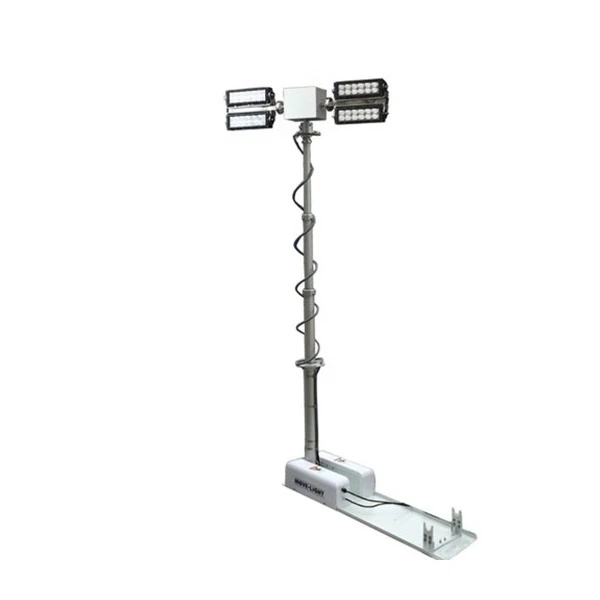

Leg Material and Construction
The material used to make the legs is super important. Most of the LED tripod light towers we supply are made with high - quality aluminum or steel. Aluminum is lightweight, which makes the tower easy to transport, but it's also strong enough to provide good stability. Steel, on the other hand, is heavier and more durable, offering even greater stability, especially for larger and heavier light towers.
The construction of the legs also matters. Well - designed legs with a proper thickness and shape can withstand more stress without bending or breaking. For example, some of our LED Tripod Light Tower models have legs with a triangular cross - section, which provides excellent structural integrity.
Ground Surface
The surface on which the light tower is placed plays a huge role in its stability. If you're setting up the tower on a flat, solid surface like concrete or asphalt, you're in good shape. The legs can make firm contact with the ground, and the tower will stand upright without much trouble.
But what if you're working on an uneven or soft surface, like grass or dirt? That's where things can get a bit tricky. On soft ground, the legs may sink in, causing the tower to tilt. To combat this, many of our light towers come with adjustable feet or spikes. The adjustable feet can be extended or retracted to level the tower on uneven ground, while the spikes can be driven into the ground to provide extra grip on soft surfaces.
Height and Weight Distribution
The height of the light tower and how the weight is distributed also affect stability. Taller light towers are generally less stable than shorter ones because they have a higher center of gravity. When the center of gravity is high, it's easier for the tower to tip over, especially if there's any external force acting on it, like wind.
To counteract this, we design our light towers with a low - lying battery or power source, which helps to keep the center of gravity as low as possible. Additionally, the LED lights are usually placed in a way that distributes the weight evenly across the tower.
Testing the Stability
At our company, we take stability seriously. Before we release any new Portable LED Light Tower model to the market, we conduct a series of rigorous tests.
We test the towers on different surfaces, including flat concrete, uneven gravel, and soft grass. We also simulate various weather conditions, such as strong winds, to see how the towers hold up. By doing these tests, we can ensure that our light towers meet the highest standards of stability and safety.
Real - World Applications
Our LED tripod light towers are used in a wide range of applications, from construction sites to outdoor events. In each of these settings, stability is crucial.
On a construction site, for example, the light tower needs to be able to withstand the vibrations from heavy machinery and the movement of workers. If the tower isn't stable, it could fall over and cause damage to the equipment or, even worse, injure someone.
At outdoor events, like concerts or festivals, the light tower needs to stay upright in all kinds of weather conditions. Wind, rain, and even accidental bumps from people passing by can pose a threat to its stability. That's why our Foldable Light Tower models are designed to be not only easy to transport but also extremely stable.
Ensuring Optimal Stability
As a user, there are a few things you can do to ensure the optimal stability of your LED tripod light tower.
First, always make sure to set up the tower on a suitable surface. If the ground is uneven, use the adjustable feet to level the tower. If it's soft, drive the spikes into the ground.
Second, follow the manufacturer's instructions carefully when setting up and using the tower. Don't overload the tower with additional equipment or accessories that could throw off its balance.
Finally, regularly inspect the tower for any signs of damage or wear. If you notice any cracks or bends in the legs, or if the adjustable feet or spikes aren't working properly, get them repaired or replaced as soon as possible.
Conclusion
So, to answer the question of how stable the tripod of an LED tripod light tower is, it depends on several factors, including the leg material, the ground surface, the height, and the weight distribution. But with high - quality construction, proper design, and a little bit of care from the user, our LED tripod light towers can provide excellent stability in a wide range of applications.
If you're in the market for a reliable and stable LED tripod light tower, we'd love to hear from you. Whether you're a contractor looking for a light tower for your construction site or an event organizer in need of some portable lighting, we've got the perfect solution for you. Just reach out to us, and we'll be happy to discuss your specific needs and help you find the right light tower for your project.
References
- Engineering Principles of Tripod Structures, Mechanical Engineering Journal, 2022
- Testing Standards for Portable Lighting Equipment, International Lighting Association, 2023