

As a supplier of mobile camera towers, I've witnessed firsthand the critical importance of stability, especially in windy conditions. Mobile camera towers are versatile tools used in a wide range of applications, from surveillance at construction sites to event monitoring. However, their effectiveness is often compromised if they cannot withstand the forces of nature, particularly strong winds.
Understanding the Basics of Wind Forces on Mobile Camera Towers
To comprehend the stability of mobile camera towers in windy conditions, we first need to understand the nature of wind forces. Wind is essentially moving air, and when it encounters an object like a mobile camera tower, it exerts pressure on it. This pressure can be divided into two main types: static pressure and dynamic pressure.
Static pressure is the pressure exerted by the wind on the surface of the tower when the wind is not moving relative to the tower. Dynamic pressure, on the other hand, is the pressure created by the motion of the wind. The combination of these two pressures results in a net force acting on the tower, which can cause it to sway, tilt, or even collapse if the tower is not properly designed and installed.
The magnitude of the wind force acting on a mobile camera tower depends on several factors. One of the most significant factors is the wind speed. As the wind speed increases, the force exerted on the tower increases exponentially. For example, according to the formula for wind force, (F = 0.5\times\rho\times V^{2}\times C_{d}\times A), where (\rho) is the air density, (V) is the wind speed, (C_{d}) is the drag coefficient, and (A) is the cross - sectional area of the tower exposed to the wind. A small increase in wind speed can lead to a large increase in the wind force.
Another important factor is the shape and size of the tower. A tower with a larger cross - sectional area will experience a greater wind force compared to a tower with a smaller area. Similarly, the shape of the tower can also affect the drag coefficient (C_{d}). A streamlined shape will have a lower drag coefficient, meaning it will experience less wind force compared to a non - streamlined shape.
Design Features for Enhanced Stability
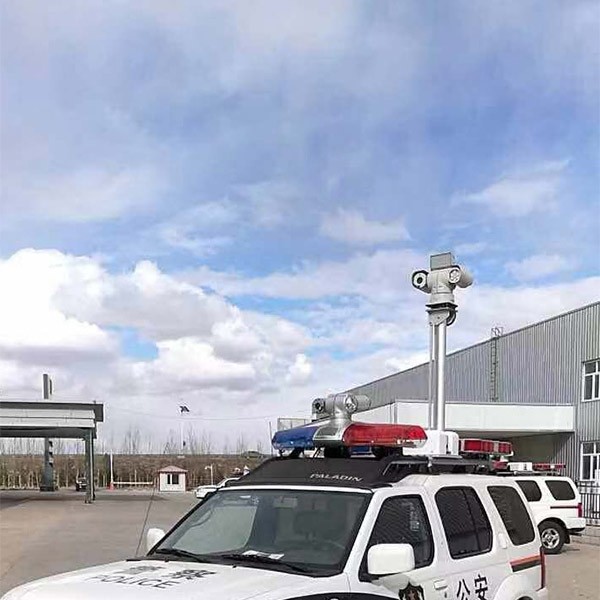
At our company, we take several design measures to ensure the stability of our Mobile Camera Tower in windy conditions. One of the key design features is the use of a wide base. A wider base provides a larger footprint, which increases the tower's resistance to tipping over. The weight distribution of the tower is also carefully considered. By placing more weight at the bottom of the tower, we lower the center of gravity, making the tower more stable.
We also use high - strength materials in the construction of our towers. Materials such as steel and aluminum offer excellent strength - to - weight ratios, allowing us to build towers that can withstand high wind forces without being overly heavy. Additionally, the structural design of the tower is optimized to resist bending and torsion forces caused by the wind.
For our Telecopic Camera Tower, we have incorporated advanced locking mechanisms. These mechanisms ensure that the telescopic sections remain firmly in place even under strong wind loads. This is crucial because any movement or looseness in the telescopic sections can compromise the overall stability of the tower.
Installation and Anchoring
Proper installation and anchoring are just as important as the design of the tower itself. When installing a mobile camera tower, it is essential to choose a suitable location. The ground should be level and stable to provide a solid foundation for the tower.
We recommend using appropriate anchoring systems to secure the tower to the ground. These can include ground screws, concrete blocks, or tie - down straps. The type of anchoring system used depends on the specific application and the ground conditions. For example, in soft or sandy soil, ground screws may be more effective, while in hard - packed soil or concrete, concrete blocks or tie - down straps may be sufficient.
During the installation process, it is also important to follow the manufacturer's instructions carefully. This includes ensuring that all bolts are tightened to the correct torque and that all components are properly assembled. Any mistakes during the installation can significantly reduce the tower's stability in windy conditions.

Testing and Certification
To ensure the reliability of our mobile camera towers, we conduct rigorous testing in simulated windy conditions. Our testing facilities are equipped with wind tunnels that can generate wind speeds similar to those experienced in real - world scenarios. During these tests, we measure the tower's response to the wind, including its sway, tilt, and any structural deformations.
Based on the test results, we make any necessary adjustments to the design or construction of the tower. We also ensure that our towers meet relevant industry standards and certifications. These standards are established to ensure the safety and performance of the towers in various environmental conditions, including windy conditions.
Real - World Performance
In real - world applications, our Portable Camera Tower have proven their stability in windy conditions. We have received positive feedback from our customers, who have used our towers in locations with high wind speeds, such as coastal areas and open plains.
For example, a construction company in a coastal region used our mobile camera tower for site surveillance. Despite experiencing strong winds during a storm, the tower remained stable and continued to function effectively. This not only ensured the security of the construction site but also saved the company from potential losses due to equipment damage or downtime.
Contact for Purchase and Consultation
If you are in need of a reliable and stable mobile camera tower for your project, whether it's for surveillance, event monitoring, or any other application, we are here to help. Our team of experts can provide you with detailed information about our products, including their performance in windy conditions. We can also assist you in choosing the right tower for your specific needs and provide guidance on installation and maintenance.
Don't hesitate to reach out to us to discuss your requirements and start the procurement process. We look forward to working with you to provide the best mobile camera tower solution for your project.
References
- Simiu, Emil, and Richard H. Scanlan. Wind Effects on Structures: Fundamentals and Applications to Design. John Wiley & Sons, 1996.
- ASCE 7 - 16, Minimum Design Loads and Associated Criteria for Buildings and Other Structures. American Society of Civil Engineers, 2016.
- ISO 4359:2017, Wind turbines — Design requirements. International Organization for Standardization, 2017.